

At Providence College, Angie Pierre ’25 found a path to the ancient world
By Liz F. Kay
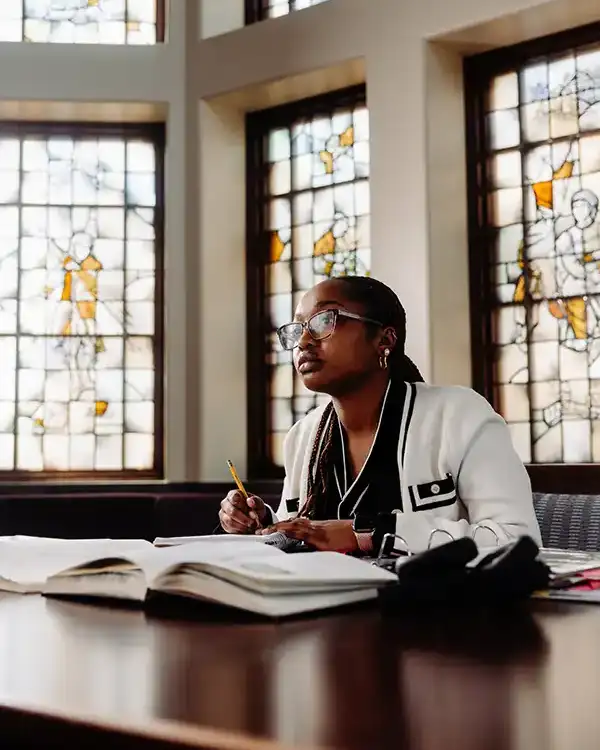
Angie Pierre ’25 was uncertain about a major when she arrived at Providence College. By the time she graduated, she had explored her passions, led student groups, presented independent research, and identified steps toward her future career.
Now, the history and global studies double major and anthropology minor is studying ancient languages in a two-year post-baccalaureate classics program at Rutgers University to prepare for a doctoral program. Next year, she will start a master’s degree program in public administration or museum studies, part of her goal to work on international museum repatriation for an organization such as the United Nations Educational, Scientific and Cultural Organization, UNESCO.
Pierre said she found people and places at Providence College that supported and guided her as she pursued her interests.
“I never said no when an opportunity presented itself,” Pierre said. “I knew I could learn something from it and that I would come out of it a different person because of the knowledge I gathered.”
She grew up in Phillipsburg, New Jersey, on the Pennsylvania border. She knew she was going to be a Friar since elementary school, when she visited her older sister, Landy Pierre ’14.
“When I was applying, I didn’t tour because I thought, ‘How much could it have changed?’” she said. “And then I came, and it had changed a lot.”
Pierre was uncertain what to study, and her sister recommended that she take time to explore her options. She took a one-credit Introduction to Providence College course for undeclared students taught by Amy Goggin ’93, ’13G, assistant director of the Center for Engaged Learning, who asked students to write about their interests.
Pierre acknowledged that her interests might be unique. She had always loved history, “because it’s like someone’s telling a story, a story that actually happened.”
After reading Pierre’s submission, Goggin recommended she take a job as a paid research assistant with Alyssa Lopez, Ph.D., who teaches history and Black studies. Pierre helped Lopez research Black cinema and its relationship to Black identity and American society and presented what she learned at the annual Celebration of Student Scholarship and Creativity that year.
Pierre applied to join the Civ in London program, which allows sophomores to take their second-semester Development of Western Civilization colloquium during a semester studying in London. The faculty leaders, Elizabeth A. Bridgham, Ph.D. and Robert E. Stretter, Ph.D., both associate professors of English, taught a lesson on museum repatriation and the British Museum, which sparked Pierre’s interest.
The museum is under pressure to return contested artifacts in its collection, such as the Parthenon Marbles from Greece, the Benin Bronzes from Nigeria, and the Rosetta Stone from Egypt.
“That’s how I decided I wanted to have that as a career,” Pierre said.
During Pierre’s semester abroad, she examined with her own eyes works of art that she had only encountered online. As a high school student during the pandemic, she was engrossed in YouTube videos about art history, such as the neoclassical painting of Phaedra and Hippolytus by the French painter Pierre-Narcisse Guérin. While in Providence, Pierre saw a sketch of the work at the RISD Museum. Then, while abroad as a sophomore, she saw it at the Louvre in Paris.
“I thought, ‘Oh my goodness, I cannot believe I’m seeing this in real life right now,” Pierre said. “There were so many things I saw that I had been reading about that I was nerding out.”
Pierre’s senior thesis explored how race was depicted in ancient Greek vase scenes and what those images revealed about the structure of that society. She was inspired by a vase that depicted Heracles as a Black man that Elizabeth Palazzolo, Ph.D., assistant professor of history, showed as part of her course, Race and Ethnicity in the Ancient World.
It was a welcome discussion, because in history classes when Pierre was growing up, lessons on Black history often implied that Black people weren’t historically relevant until the 1400s.
“I was really fed up with the notion that Black history begins when the trans-Atlantic slave trade begins, and that the only Black history is this history of suffering,” she said.
Logically, she knew that people in ancient Greece and Rome had encountered people from Africa.
“Africa is right there. It’s really close,” Pierre said. “There’s no way that no one saw a Black person until slavery.”
Palazzolo, who became Pierre’s thesis advisor, helped her find resources. Pierre received a summer undergraduate research grant from the Center for Engaged Learning that allowed her to travel to the Museum of Fine Arts in Boston, the University of Pennsylvania’s anthropology museum, and the Metropolitan Museum of Art in New York City, where she was able to get a card to check out library materials and to use the grant to order resources and supplies.
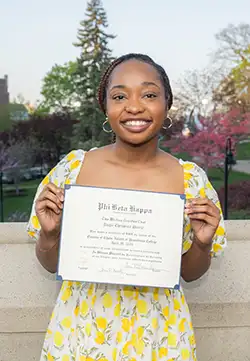
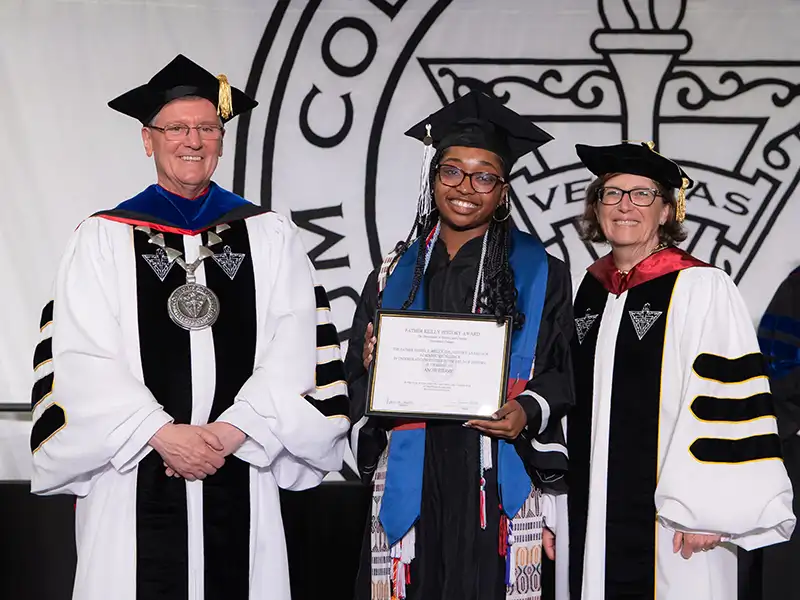
Pierre’s thesis was one of five projects chosen to represent PC at the BIG EAST Undergraduate Research Symposium, held at Madison Square Garden during the men’s basketball tournament in March 2025. During Commencement weekend, she received the college’s Rev. Daniel F. Reilly, O.P. Award for excellence in historical scholarship.
Her research also included Princess Andromeda, an Ethiopian princess. She learned about Andromeda on YouTube during the pandemic. When Pierre came to Providence, she saw a Renaissance painting at the RISD Museum depicting Princess Andromeda as a white woman. But art from ancient Greece represented her with Persian features.
“I was confused,” Pierre said. “She’s an Ethiopian princess. How does that work?”
Pierre also served as an undergraduate editorial researcher for Trina Vithayathil, Ph.D., professor of global studies, helping to edit her book, Counting Caste: Census Politics, Bureaucratic Deflection & Brahmanical Power in India, and returned to PC to join an interdisciplinary panel for the book launch in November 2025.
Pierre’s extracurricular activities were varied as well. Someone scrolling through the college’s social media channels might have spotted her playing Steve Harvey at a Family Feud event for the History Club — she served on the executive board since sophomore year — or at practice with the Club Fencing team, a group she helped start as junior with Jade Mikalauskis ’25 and Matthew Tuccillo ’25. As a first-year student, Pierre was part of PC’s Model United Nations team, representing Rwanda.
At Commencement, she also received the Sister Thea Bowman Award for outstanding service to the college and local community. For example, she helped organize a toy drive for the Smith Hill Community Development Corporation through the Board of Multicultural Student Affairs’ outreach committee during her junior year.
Pierre, Callie Raacke ’25, and Martina Scarpa ’25 applied for a grant from the Providentia Endowed Fund, which supports projects that enhance the experience of women at PC. They and other students organized two events to help students with higher education aspirations find mentors and network with women in academia.
Pierre is now studying Latin and Greek at Rutgers and also studied French, Italian, and Arabic at PC. Her parents, who are from Haiti, support her quest to become a reverse Indiana Jones, returning antiquities held in museums and private collections to the countries and communities to which they belong.
She sees opportunity in having museums associated with the United Nations or other organizations facilitate collaborations to allow items to be borrowed ethically.
“I think it’s important for countries who have had their artifacts stolen from them given back, especially if they’re religiously or culturally important,” Pierre said.