Chemistry major Leart Jahaj ’27 awarded prestigious Goldwater Scholarship
Chemistry major Leart Jahaj ’27 awarded prestigious Goldwater Scholarship
By Vicki-Ann Downing ’21G
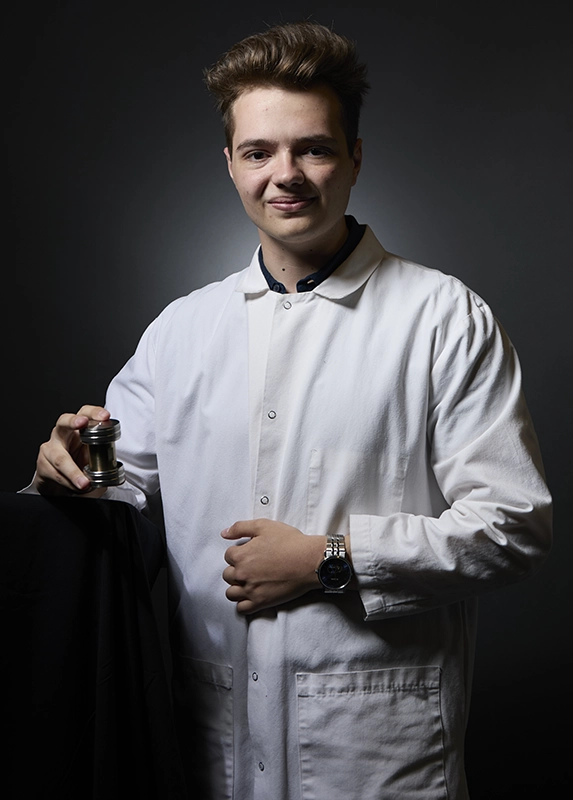
As a child, Leart Jahaj ’27 had questions. How does rust form on metal? How does wood burn in a fireplace? How does ice melt on your palm?
That curiosity drew him to study science. At Providence College, where he chose to major in chemistry, Jahaj joined the research laboratory of Adelaide Clark, Ph.D., assistant professor of chemistry, who studies particulate matter in the air.
In March, Jahaj learned that he was one of 454 students in the country selected to receive a 2026 Goldwater Scholarship, the most prestigious undergraduate scholarship in the United States in the fields of engineering, mathematics, and natural sciences. He will receive up to $7,500 from the Barry Goldwater Scholarship and Excellence in Education Foundation to use toward his education.
The Goldwater news was another bright spot in a stellar junior year. Jahaj also was accepted to join the NASA Student Airborne Research Program, an eight-week summer internship that allows college students to engage in hands-on field research and data analysis. He will be based near the Johnson Space Center in Houston, where he will fly in aircrafts to collect air samples that he will analyze later at San Diego State University. Clark, his mentor and advisor, participated in the same program during graduate school at Baylor University, and several PC biochemistry students — Francis Radics ’22, Shelby Schola ’16, and Eric Lebel ’15 — have as well.
In addition, a research paper that Jahaj co-wrote with Clark’s group, “Spatioseasonal Variability and Correlations of Particulate-Bound Organophosphate Esters in Providence, Rhode Island,” was published in Omega, an academic journal of the American Chemical Society, in a special issue dedicated to undergraduate research.
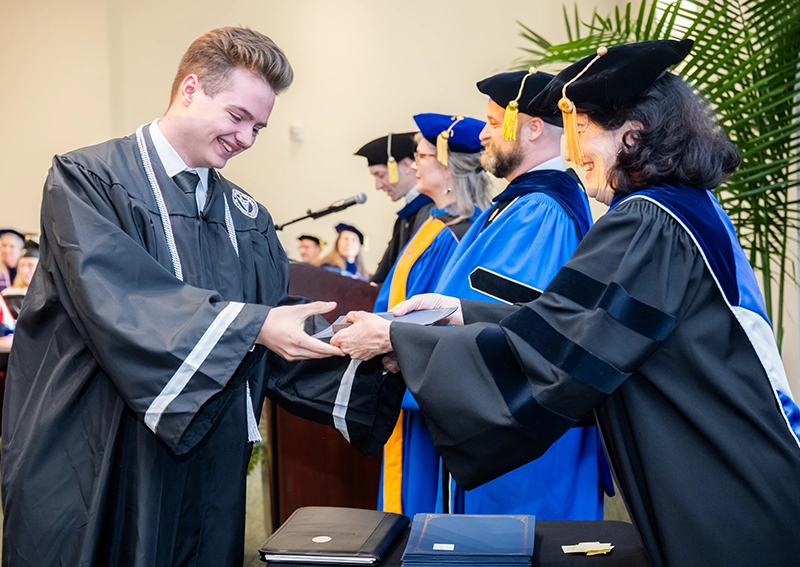
Jahaj, a member of the Honors Program and the Phi Beta Kappa honor society, also enjoys his courses in history, literature, philosophy, and the Development of Western Civilization.
“They have provided me with a holistic appreciation of the human person and society, as well as practice in public speaking and how to write concisely and clearly,” Jahaj said.
Jahaj was born in Albania and moved to Worcester, Massachusetts, with his parents when he was 18 months old. Because his parents did not initially speak English, he was forced to be self-reliant. From 7th through 12th grade, he attended the Bancroft School, a small college preparatory school, and graduated at the top of his class. With consistent parental encouragement, he thought out mathematics problems and pushed past writer’s block to finish essays.
“I didn’t know it at the time, but I was gaining the level of problem-solving skills and confidence needed if one wants to do solid research in chemistry,” Jahaj said. “I built up skills in thoughtful, creative hypothesizing, critical thinking, and perseverance. I’ve applied the same problem-solving to organic syntheses, chemical separations, and research.”
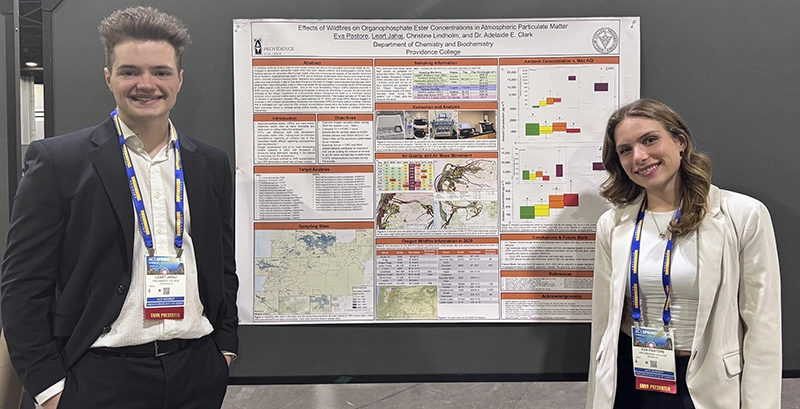
Jahaj decided to join Clark’s lab after hearing her talk about her work when she was a guest speaker in his first-year General Chemistry Laboratory class.
“Dr. Clark spoke about how, through the use of filters and samples on campus, she could extract and analyze the very particulates, smaller than a strand of human hair, that we breathe in our day-to-day lives,” Jahaj said. “She explained how each sample gave invaluable information about a relatively new and understudied class of pollutants. I was completely enthralled.”
Clark’s lab uses air samplers on the roof deck of the PC Science Complex, at the Port of Providence, and at Roger Williams University. In the lab, Jahaj runs extraction processes on the air samples, quantifies peak sample data, and creates correlation graphs and trends, learning along the way how to cope with instrument failure and sample contamination. His summer research was supported in 2025 by a Robert H. Walsh ’39 Student Research Fellowship and in 2024 by the Rhode Island IDeA Network of Biomedical Research, known as RI-INBRE.
Clark said she can count on Jahaj to complete important tasks, often independently, because he learns so quickly. He stepped into a leadership role in the lab early, helping other students learn processes of extractions and analysis, she said.
“It has been really wonderful for me to be confident that the things I need to get done will be done and done well because Leart is working in the lab that day,” Clark said. “He works hard to teach the newer students our research techniques and is a fantastic mentor and role model.”
Clark said Jahaj has been looking at local air samples that contain concentrations of chemicals used in flame retardants and plasticizers. Through his diligent work and curiosity, the group was able to make conclusions about the data that was included in a research proposal that Clark submitted to the National Science Foundation.
“I know I would not have had the time to consider all of these aspects of the data myself and I don’t believe a lesser student would have had the drive to discover them on their own,” Clark said. “Leart possesses several qualities vital to this research project. He is naturally curious and excited by the work we are doing and the impact it could have, he pays attention to detail, which is vital to our analytical chemistry work, and he asks questions when he has them.”
Jahaj arrived at PC without choosing a major. He knew he wanted to study science and was interested in the environment. He chose chemistry because it made him think.
“I liked the problem-solving and critical thinking aspect of chemistry,” Jahaj said. “It forces you to think about how to solve the world’s most pressing problems, environmental and otherwise.”
“Chemistry shows how interconnected the world is,” Jahaj added. “The idea that science and faith can’t be reconciled is completely false. If you look at how science behaves in the natural world, you come to see that the entire world is interconnected.”
Jahaj said he has enjoyed the intellectual, philosophical conversations in his liberal arts classes as much as his chemistry research. “Cheminars,” in which students present and defend a research paper to faculty members at the end of junior year and at the beginning of senior year, helped build his confidence in public speaking.
Jahaj’s goal is to receive a Ph.D. in chemistry, conduct research in environmental science, and work in industry. He is the college’s fifth Goldwater recipient since 2019. Kathleen Cornely, Ph.D., the Robert H. Walsh ’39 Professor of Chemistry and Biochemistry, is PC’s Goldwater representative. Darra Mulderry, Ph.D., associate director of the Center for Engaged Learning and director of national and international fellowships, assists with applications. A total of 1,485 undergraduate students across the country sought the award this year.
“I’m grateful for the opportunities I’ve been given,” Jahaj said. “It’s been a wonderful experience. Everything I’ve been working toward has somehow come to fruition.”