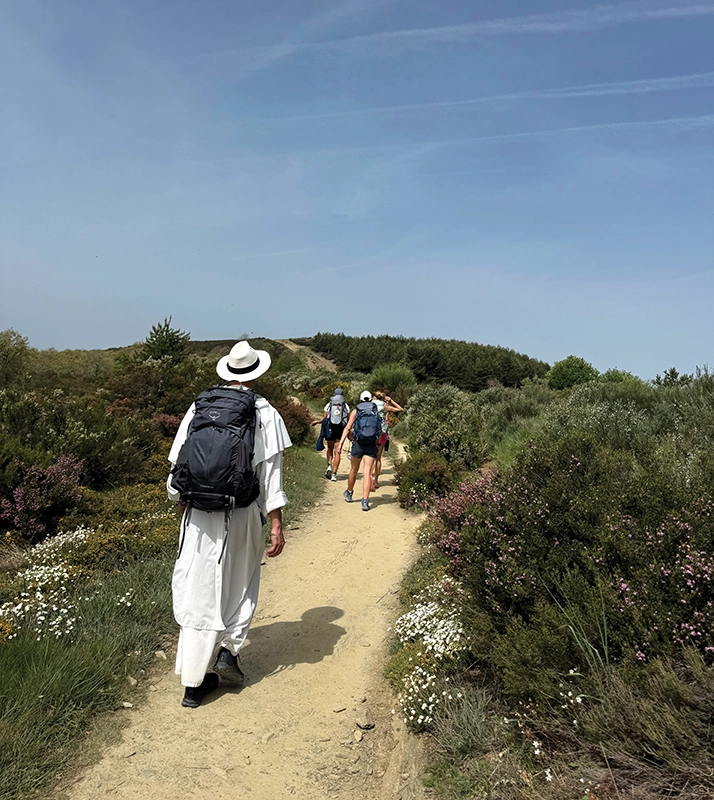

Buen Camino
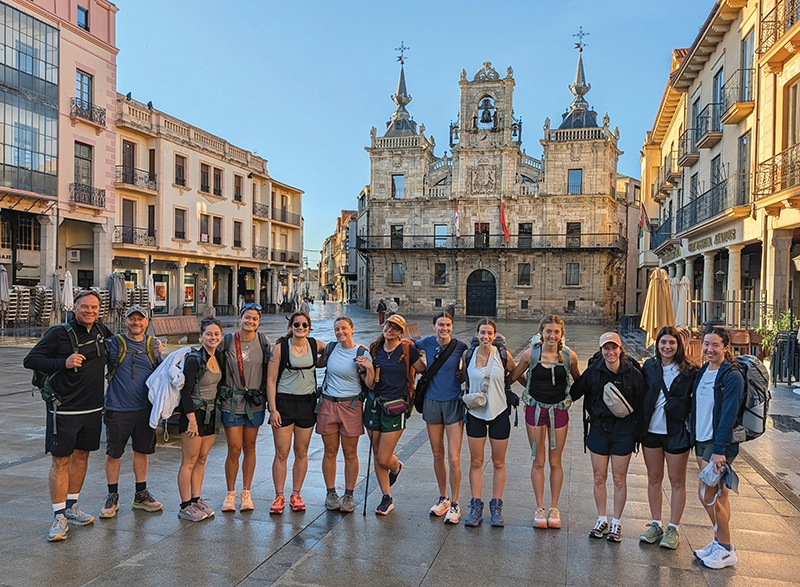
Buen Camino
In May 2026, 11 student-athletes from four Division I teams completed a 160-mile pilgrimage along the Camino de Santiago in Spain. Led by Rev. Dominic Verner, O.P., they traveled the ancient route to the Cathedral of Santiago de Compostela, which houses the remains of the apostle St. James.
By Isabella Marcos ’28
The first thing I noticed when reaching Santiago wasn’t the cathedral but the silence. Until that point, the Camino de Santiago had been loud, physically and mentally. From connecting with people all over the world, to feeling the aching pain in my legs and shoulders from the physical demand of the pilgrimage, there was no such thing as silence. Before I knew what was happening, tears were streaming down my face. When I looked around, I realized I wasn’t the only one. Pilgrims embraced strangers and stood in silence, staring at the Cathedral of Santiago de Compostela. I could hear conversations in languages I didn’t recognize, but I didn’t need to understand the words. Their faces said everything.
I had spent days believing I was walking toward Santiago. In that moment, I realized I had been walking toward a different version of myself.
One of the most beautiful aspects of the Camino is that everyone starts from a different place. Some pilgrims had walked for only six days, while others had spent nearly two months crossing Spain. No matter where we started or how far we had walked, the emotion was the same. My father, who was born in Asturias, Spain, walked El Camino Primitivo in 2013. When he returned, I could tell the experience had moved him. Ever since, I had wondered what it was about a long walk across Spain that could affect someone so deeply. When I was given the opportunity to walk it myself, I wanted to find out. Before I left, my dad spent hours sharing his Camino with me. He showed me more than 200 photographs, pointed out places I would soon see with my own eyes, and told stories from every stage of his journey. In many ways, it felt like I had already walked the Camino beside him long before I ever set foot in Spain.
What I didn’t realize was that my own experience would be shaped not only by the trail itself, but by the people I would walk it with. I was fortunate to share the Camino with 10 other student-athletes from women’s ice hockey, swimming and diving, tennis, and track and cross country, along with three incredible mentors: athletics chaplain Rev. Dominic Verner, O.P.; Erich Miller ’20Hon., and PC parent John Barry. What started as an individual journey gradually became a deeply spiritual experience that brought our group together in ways I never expected. Although every day brought new physical and mental challenges, it was often the quiet moments in between that changed me the most.
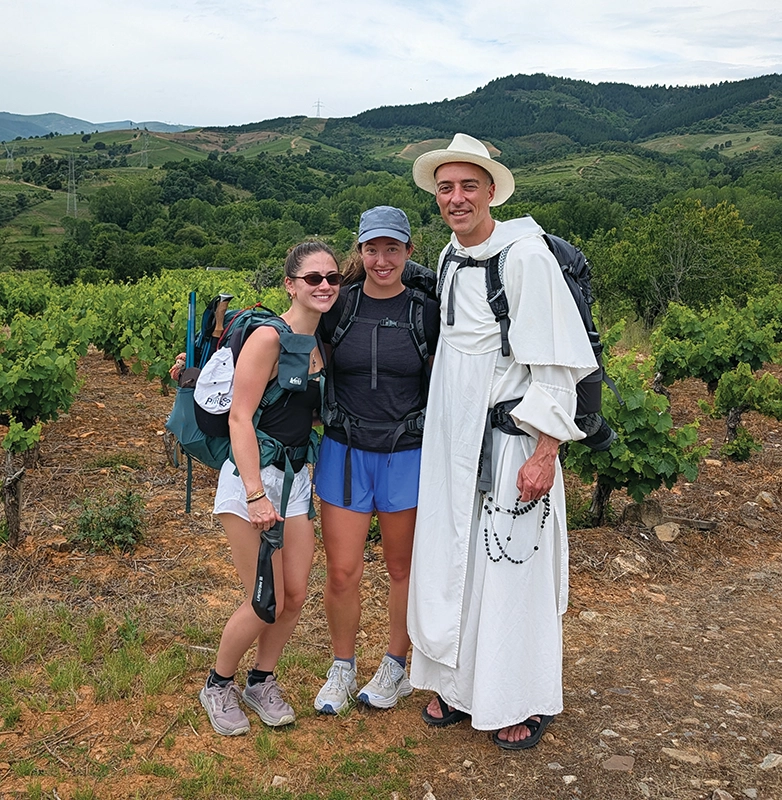
It is impossible to understand how life-changing the Camino can be until you experience it firsthand. Through days spent walking through mountains and small towns with nothing but yellow arrows guiding the way, life became surprisingly simple. Wake up, walk, eat, pray, sleep, and do it all again the next day.
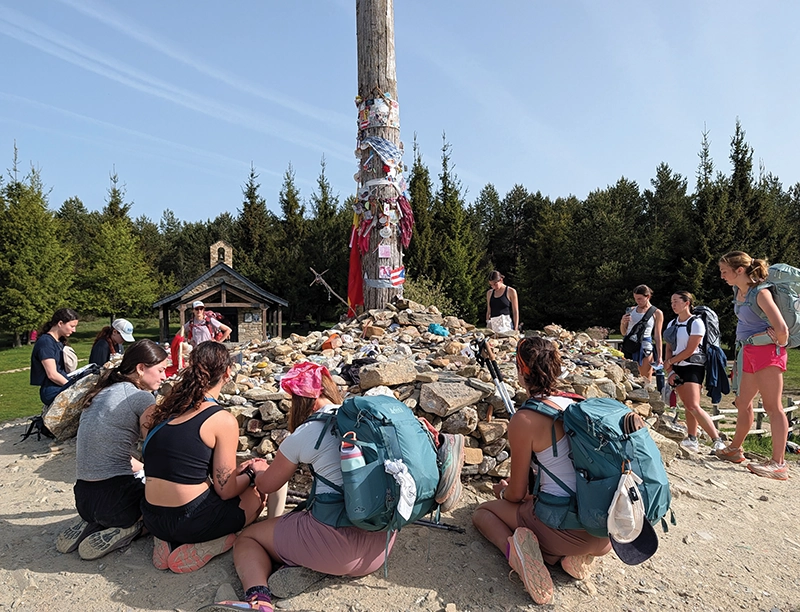
Some of the moments that left the biggest impact happened long before I ever saw the cathedral. One took place at La Cruz de Ferro. After hours of climbing, we reached the highest point of the Camino Francés. Standing 1,500 meters above sea level, La Cruz de Ferro is an iron cross surrounded by a mountain of stones, photographs of loved ones, handwritten messages, and flags representing countries from around the world. Pilgrims carry a stone from home and leave it at the base of the cross as a symbol of letting go. That morning our spirits were high — it was our first 20-mile day. The beginning was physically challenging, but still relaxing. When I arrived to place my stone, I felt an energy shift from our group. It was the first time we had a moment to stop walking and take it all in. Feeling the vulnerability from the people around me allowed me to feel I was in a safe space to express those emotions.
Leaving La Cruz de Ferro, exhaustion hit almost immediately. We still had 15 miles to go. As our group naturally spread out along the trail, I found myself walking beside Father Dominic for nearly the entire second half of the day. What began as casual conversation slowly turned into one of the most meaningful discussions I’ve ever had. I felt I could not only be myself but be honest. There was no pressure to have everything figured out or pretend I had all the answers. We talked about family, faith, purpose, school, and the uncertainty of what comes next. For the first time in a long time, I felt like I could say exactly what was on my mind without worrying about being judged.
Somewhere along those miles, I stopped thinking about how much my shoulders hurt or how tired my legs felt. The physical pain that had consumed my thoughts all morning slowly faded into the background. For a while, I forgot I was even walking. Of course, that feeling didn’t last. The last three miles were spent complaining about how exhausted we were, laughing through sore feet and aching legs. Looking back, I think that’s what made the Camino so special. The most meaningful moments weren’t separate from the difficult ones. They happened because of them.
Days started blurring together after that, one town into the next, until suddenly we were almost halfway, and it was my birthday. I consider myself to be optimistic, but not when it comes to birthdays. I woke up excited, which is not how I would normally feel. The best gift was Elizabeth Glasspool ’26 taking my bag on the walk so I could get some relief for my shoulders. The day was perfect, with a variety of scenic views ranging from mountains to farms. It was unfortunately a long day of walking, and I can’t lie, it was painful, but someone was always there to make it easier. After arriving at our destination, Villafranca del Bierzo, we sat down for our group dinner. I had no idea Father Dominic had arranged anything, so when a cake came out, candles lit, I was completely caught off guard. In that moment, I felt truly happy; not just celebrated but loved by people I’d known for less than two weeks.
For our final walk, 13 miles, we walked as a group, no one split off. Excitement was all around and lingered until four miles were left. Polly Bogdan ’27 asked me, “Do you think you are walking in the same steps as your dad?” I was speechless. It was an incredible moment and a chance to reflect about why I was there in the first place. It gave me motivation to not only finish but to do it with pride. At three miles left, we reached a beautifully decorated sign that said, “Santiago de Compostela.” On the sign were shoes from other pilgrims, so Polly, Luci West ’29, and I decided to we should leave ours as well.
The final stretch, one mile left, brought us right in the center of Santiago. The streets were filled with Camino souvenirs and shops. There were sounds of bagpipes echoing and people talking, hugging, taking photos, calling loved ones. I sat on the ground, letting my bag fall beside me, legs finally still. The noise around me didn’t disappear but it stopped mattering. I could feel the silence starting to settle in, the same one I would feel looking up at the cathedral minutes later. I hadn’t come to Santiago looking for a building or a finish line. I’d come looking for that silence, for the kind of peace that only shows up once you stop moving long enough to let it.
Isabella Marcos ’28, from Pittsburgh, Pennsylvania, is a member of the swimming and diving team. She studies biology on a pre-med track and is minoring in Spanish.