

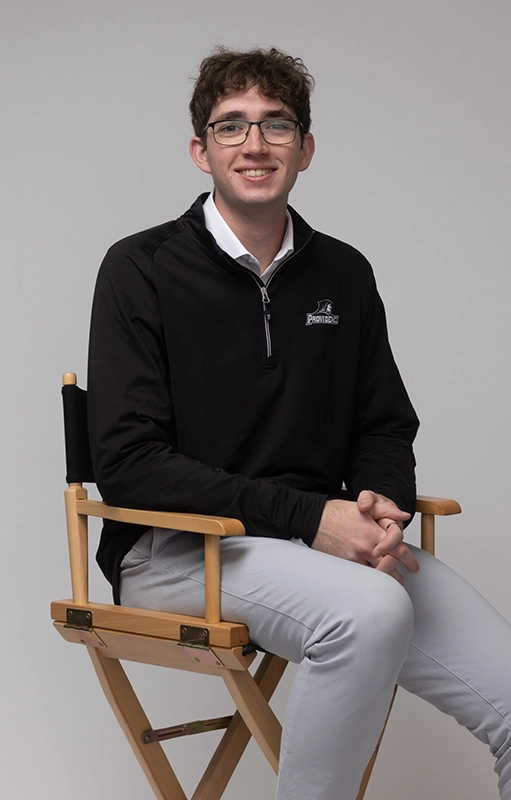
Economics major Nathan Cross ’26 charts career course blending athletics and analytics
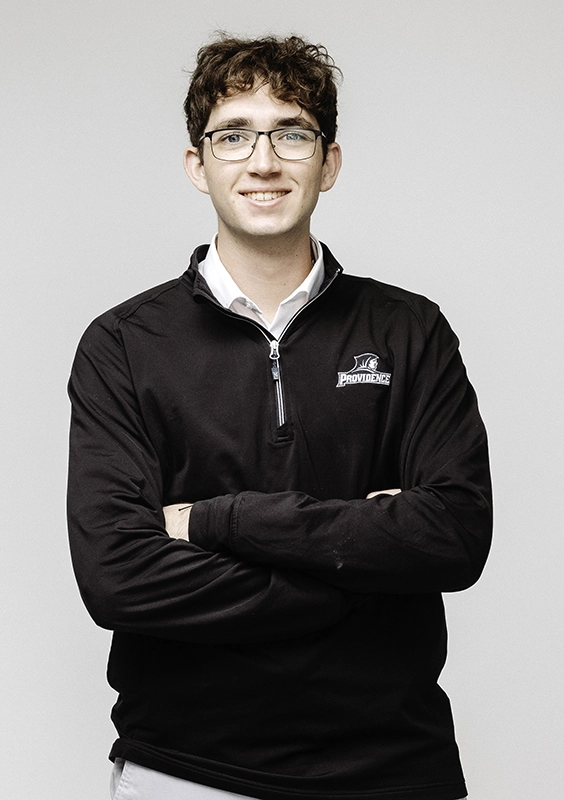
Economics major Nathan Cross ’26 charts career course blending athletics and analytics
By Sandy Coleman
Every journey to and through Providence College is different. The path that Nathan Cross ’26 took included a gap-year detour that allowed him to earn money to help pay for college, gain work experience in the sports industry, and arrive at PC ready to pursue his long-term goal of becoming a college director of athletics.
“It was an important period of personal growth for me. I wasn’t necessarily unprepared for college, but I wasn’t fully ready either. That year bridged the gap between being in high school and being much more independent,” Cross said. “I still lived at home, but I was doing things on my own, and it made me more confident and more prepared to show up for myself when I got to PC.”
That foundation has supported him throughout his time in college. Cross has steadily moved toward his goal by majoring in quantitative economics with a mathematics minor and pursuing hands-on experiences in marketing, data analytics, and research. He has developed leadership skills as an executive officer in Student Congress and has applied his knowledge through internships both on and off campus.
Along the way, he also has stayed connected to athletics, a focus throughout his life. His father, Michael Cross, is commissioner of the NCAA Division I Southern Conference. The 6-foot-4-inch-tall Nathan played basketball in high school in his hometown of State College, Pennsylvania. While he knew making PC’s Division I men’s team would be a long shot, he found another way to be involved by becoming a practice player for the women’s basketball team during his first year of college.
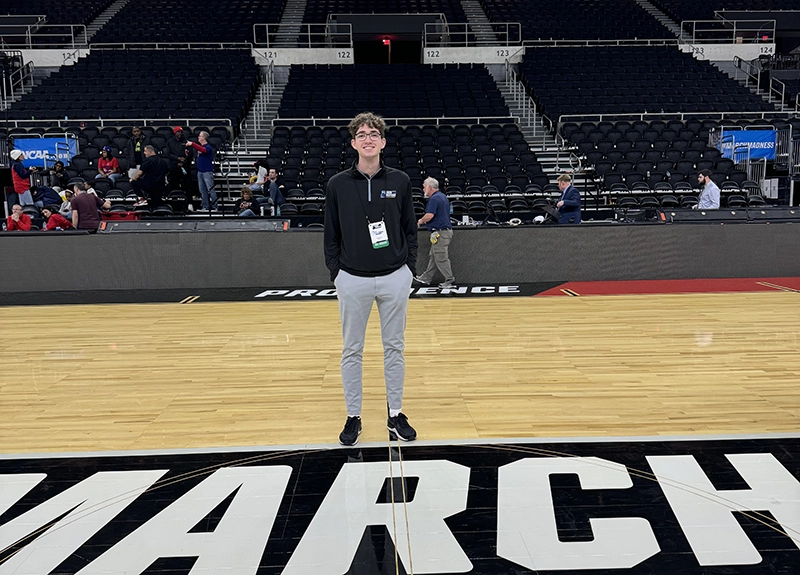
Once or twice a week, Cross attends practices, runs plays as an opponent might, and provides overall support of the team’s preparation.
“I’ve played sports my entire life. I love basketball. But more than that, I love feeling like I’m contributing, even in a small way, to a team’s success,” said Cross, who also plays on a PC intramural basketball team.
On his clearly mapped route toward a career in athletics, Cross initially chose quantitative economics as a practical major that would provide analytical skills valuable in a competitive industry. Over time, however, he developed a deeper passion for the discipline, crediting professors Michael Mathes, Ph.D., associate professor of economics, and Leo Kahane, Ph.D., professor of economics, for deepening his interest.
This semester, Cross, who is in the Honors Program, is conducting research with Mathes on the impact of alcohol sales in Division I football stadiums on drunk driving fatalities.
The quantitative economics major focuses on how money, markets, and organizations make decisions, as well as how data and numbers can be used to explain why those decisions matter.
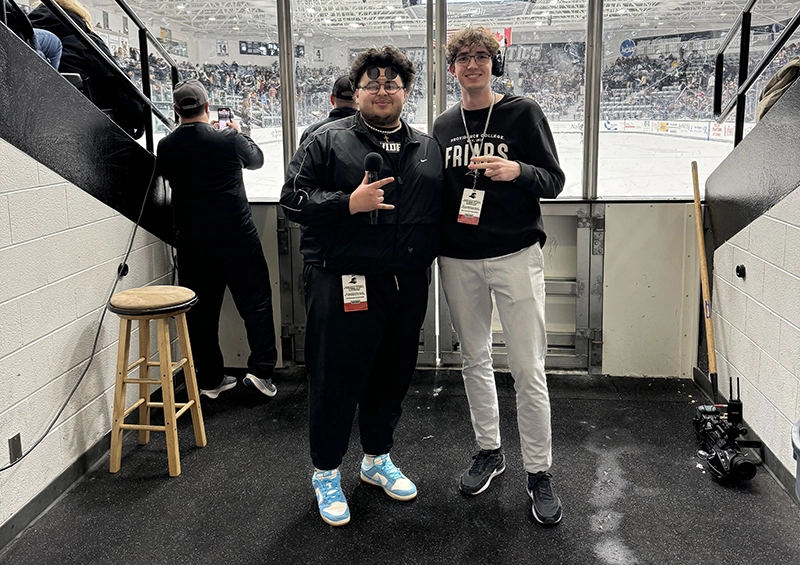
Cross has applied what he has learned through a variety of roles both on and off campus. For the past three years, he has worked with the PC Athletics marketing team as a game-day assistant for hockey and basketball. Last summer, he served as a ticket office analytics intern, contributing to data-driven donor engagement tools. Currently, he works with the development team, helping ensure that hospitality areas run smoothly during Friars basketball and hockey games.
For his Introduction to Econometrics with Computing Lab class sophomore year, Cross analyzed PC Athletics data to evaluate the effectiveness of email communications in driving ticket sales by examining open rates, clickthrough rates, and other factors. He shared his findings with the athletics team to help with strategy.
Andrew Schoepfer, senior associate athletics director for revenue generation and business management, said that Cross’s analytical work has been important in finding creative ways to build the fan and donor base.
“College athletics is in a transformational period. The pro space has been leveraging data at a high level for over a decade, and college athletics is now just starting to catch up. So, there is a big demand for administrators who start from a place of data-driven decision making,” Schoepfer said.
“College athletics administrators of the future are going to need a strong foundation in analytical thinking to be successful because that’s what donors and trustees are going to want. Being exposed to the types of data that we are using, the ways we explore and tell stories with our data, while aligning them to our organizational goals, hopefully will provide Nathan a template that he can take with him to make an impact at whatever organization he ends up with. I’m sure he’ll be successful wherever he goes,” Schoepfer said.
Cross said he values the experiences that contribute to his growth.
“In classes, you’re responsible for yourself. In internships, you are responsible for yourself, and other people are counting on you,” he said. “That sense of pride in your work translates to being dependable and attentive, and taking ownership of the work.”
As a rising junior, Cross interned with the Hub City Spartanburgers, a new minor league baseball team in South Carolina, where he learned to be agile while helping build the organization. His responsibilities included working with corporate sponsors and assisting with merchandise and marketing.
“There was one day when I showed up and they said, ‘We need a model for this social media shoot,’” Cross said. “I had never modeled anything, but they put a jersey on me, and I ended up in their promo video. I had a bunch of random responsibilities, and it was cool to be on the ground floor of something that later became a big deal in the community.”
He has also enjoyed being involved on campus.
“Student Congress has filled my life with these unexpected experiences. I went line dancing, which I never imagined doing before PC, because friends from congress invited me,” he said. “There is always someone who is down for an adventure. That has been one of the best parts.”
When Cross began his college search, he did not know exactly what he wanted, but he was aware of Providence College because of its basketball program.
“I graduated high school in 2021, so my whole college search process happened during COVID. When I visited PC, I felt this really bright energy from the student body, even though it was a dark time,” he said.
Although he was not initially looking for a liberal arts college, Cross has come to appreciate the rigorous and broad academic curriculum.
“I wasn’t excited about Civ or theology at first, but I’m grateful for them now,” he said. “They gave me a more well-rounded perspective on the world.”
As he reflects on his journey toward commencement, several experiences stand out as defining highlights.
Among them is studying in Copenhagen. Cross visited 14 countries in four months and took two economics courses — one focused on globalization and another on urban economics — along with a photography class. He lived in an apartment with 11 students from different colleges and biked everywhere. The program included educational trips to Lisbon, Porto, and Sweden. Every Wednesday students participated in field study that encouraged them to go out into the city and engage with something connected to their coursework.
Cross points to two favorite classes at PC. One was Sports Economics with Kahane that combined his two loves. The other was Beer, a 1.5‑credit humanities course for students 21 and older that uses beer as a lens to explore science, culture, and conversation. It is co‑taught by Rev. Jordan Zajac, O.P., Ph.D. ’04, assistant professor of English, and Jay Pike, Ph.D., assistant professor of chemistry.
For the final, Cross joined the two professors and a friend from the class in a visit to a local brewery.
“We sat there for about three hours — me, my friend, a friar, and a chemist — drinking beer and talking,” he said. “It was such a fun moment.”
“It felt like it summarized the Providence College experience for me: community, connection, learning, all happening together in this really natural way,” he said. “And it was not just about drinking beer. I learned a lot in that class.”
Beyond Limits: The Campaign for Providence College is building the future of academics, financial access, and the student experience at PC. When you support the campaign through The Fund for Providence College, you make an immediate difference in the lives of students today.