A Chaplain’s Thoughts: Life is a gift from God
A Chaplain’s Thoughts: Life is a gift from God
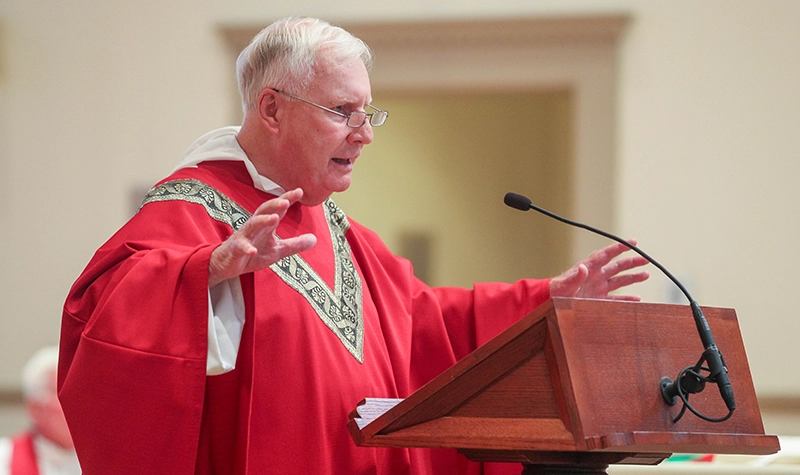
By Rev. James F. Quigley, O.P. ’60
Associate Chaplain, National Alumni Association
Life, especially human life, is a gift from God.
That is what religious people and others believe. They, certainly Catholic people, live by a moral vision of life, the value of every human life from conception to natural death. Dimensions of modern culture challenge that view and promote disrespect for human life. When a culture rejects any sense of the sacred or God, human beings then decide what is right or wrong, good or bad, valuable or not. I’d like to briefly offer Catholic teaching on some current life issues that might move a reader to investigate more.
Abortion
Abortion is a very difficult issue. As an old priest I have dealt with women and men who have experienced the issue of abortion. It is often very painful at the time and even many years later. The person or couple may have felt that they had no choice. A priest, the Church, must minister to these woman or men to accept them, assist them, reconcile them to a loving God. That woman or man may be hurting, perhaps for a long time, and in need of God’s forgiveness and love.
Massachusetts and 10 other states have legally allowed abortion in the womb at any stage of pregnancy. It means the life of an unborn child right up to birth can be terminated. The decision is up to the “professional judgment of a physician.” Without getting into medical statistics about gestation and viability, unlimited abortion certainly includes ending the life of a fetus able to live outside the womb. That should be a moral issue for everyone.
Life from conception to natural death is a gift from God. If anyone wants to speak about this, I suggest them contact a priest, a female minister, or a friend they can talk to from the heart. At least start there.
God always loves us no matter what has happened in our lives.
The Art of Dying
Ars Morendi, or The Art of Dying, was a text written in the Middle Ages, attributed by some to an anonymous Dominican. Catholic teaching promotes the value of human life from conception to natural death. Natural death today is challenged by the growing acceptance of physician assisted suicide and euthanasia. Let me offer a thought that hopefully is sensitive, humble, and reflective.
Catholic theology has taught that “extraordinary means” need not be used to prolong life when someone is suffering or terminally ill. Given technological and medical advances, it is difficult to say today what is “extraordinary.” It may also be hard to determine that someone is “dying.” The “aid in dying” movement is becoming more accepted. In this country, at least 13 states and the District of Columbia now authorize physician-assisted suicide. Why go this route? Some patients understandingly fear becoming a burden to loved ones. Choosing to end life can seem to be an act of love. Cathleen Kaveny in an article in Commonweal(September 2026) points out that the cost of growing old can wipe out inheritances, or force children to spend down their own finances and savings to pay for a parent’s care. Nursing homes can be expensive and Medicare does not cover everything. Kaveny writes: “No one without substantial wealth can take care of a person in the midst of a 10-year progression in dementia at home ….” And, of course, to see a loved one, parent, child, or friend suffer can be heartbreaking for everyone.
A Catholic vision sees, tries to see, every human person as an image of God, even a weak, needy, elderly woman or man, the mentally or physically disabled, and severely injured persons, and we try to love them. It may not always be easy. Should I view myself simply as a burden? Should I see others as burdens? What can a Catholic do?
Pray! We can offer the Sacrament of the Anointing of the Sick, asking a loving God to heal and comfort an elderly, disabled, long-term patient, or give them a peaceful death. We can visit those who are old and seriously ill to comfort them and be there for them, especially those we love and who have loved us. On a social and political level, we can promote somehow a change in the distribution of wealth so that resources can go to caring for the elderly, the sick, and dying. We can support Church efforts in care for the ill and dying. Parishes can organize women and men faithful to visit and to assist in ministering to the sick and patients in need. Many already do. We can foster palliative care and hospice-like efforts, e.g. Little Sisters of the Poor. We can assist caregivers in their efforts and dedication. We also have a theology of suffering and do not view it as worthless. Catholic teaching does see euthanasia and assisted suicide as morally unacceptable. Death and dying are a challenge for those who believe in the gospel, in the value of human life from conception to natural death. We need to think hard about this.
The death penalty
Not so long ago, news outlets and social media reported on an execution that went terribly wrong. The guilty woman did not die after two injections of pentobarbital. She is alive and now back in prison. Another story also made headlines. The U.S. Department of Defense (War) Secretary ordered an execution by firing squad and suggested it could be publicly screened. In 2025, there were 47 men executed in the United States: 39 by lethal injection, five by gas, and three by firing squad. Catholic teaching teaches the value of human life from the conception to natural death. Executions are not natural death.
To begin, it should be stated that to murder, to unjustly take the life of another human person, is a serious sin, a serious crime, an insult to the value of human life, and deserves punishment. Anyone who has lost someone by murder rightly is crushed, mourns, may understandingly be angry, wants justice, wants punishment, maybe revenge. But can you ever get even for such a loss? There has to be punishment but to what end? What kind? When? How?
A Pew Research Center claims that 65% of American Catholics favor the death penalty for those guilty of murder with 28% strongly in favor; 34% oppose it, with 15% strongly opposing it. So what does the Catholic Church teach about capital punishment?
Let me offer the official position of the Catholic Church on capital punishment. I think it deserves consideration, conversation. This is not to debate those who favor such punishment. Pope Leo posted the following: “The common good can be safeguarded and the requirements of justice can be met without recourse to capital punishment …” Pope Francis in 2018 amended the official teaching in the Catechism of the Catholic Church, #2267, to declare “the death penalty is inadmissible because it is an attack on the inviolability and dignity of the person.” The proposal to make an execution of a guilty person publicly available to viewers is to turn death into entertainment. Archbishop Paul Coakley, head of the U.S. Conference of Catholic Bishops, writes: “The public execution of one who has done grave harm will only further undermine the moral fabric of our nation.” The Catholic position is worthy of reflection and discussion.
Immigration

When I was still a young Dominican priest, I recruited a few Dominican seminarians and a group of Providence College students to work with migrant farm workers in South Carolina. We visited them in pretty rundown camps; in shacks, provided by farmers, where we celebrated Mass and an occasional baptism, and distributed needed clothes and food.
Who were these workers? Most were Mexican, some were from Puerto Rico, some were African Americans. Most were poor, depending on farm work for their livelihood. Many traveled from state to state, following seasonal crops. The job was harsh, usually hot, with long hours in fields while sweaty and thirsty, and for small pay. Most were undocumented immigrants. We loved them.
Social media and some news stations speak as though all immigrants were criminals, members of drug cartels, or desperately needed for political purposes. Of course, there are also many good willed, Catholic Church people and others who truly reach out to immigrant women, men, and children to minister to them. They imitate Christ’s command to feed the hungry, give drink to the thirsty, welcome the stranger. Immigration is, of course, a legal issue. The United States and all countries have or should have clear laws regarding entry, permanently or temporarily, into the country. But immigration is about human persons and so must also be a moral issue, an issue about human life. We should remember this when thinking, talking, and treating immigrant persons, especially children. Many are Catholic people in our pews, schools, and hospitals.
In Chicago, there is a traveling installation of 100 immigrant crosses bearing the names, ages, and countries of origin of immigrants who have died in custody or during enforcement actions. Dominican Rev. Brendan Curran, O.P. ’92 is one of the organizers of this memorial. Perhaps we can pray with him for wisdom, intelligence, and compassion for deserving immigrants searching for a better life.