

Teaching is a memory making business
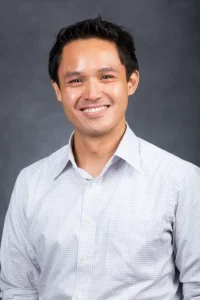
By Alex Orquiza, Ph.D.
Accinno Teaching Award Winner
My statement on teaching is best captured by San Francisco Giants great and future Hall of Famer Buster Posey. When he was introduced as the new president of baseball operations for the Giants in 2024, he summarized his approach to the job as follows: “We are in the memory making business.”
I’d like to give you three memories from the classroom that students have shared with me about what they took from my teaching.
Memory #1: Cooking Pad Thai Noodles for 39 of my favorite students in Honors 202. Sometimes, teaching post-colonialism is more than the chronology of independence from empires after World War II. It’s more than the gross income inequality that simply repeats economic patterns that previously enriched the metropole at the expense of the colony. It’s stir-frying rice noodles, tofu, bean sprouts, and peanuts seasoned with fish sauce, sugar, and lime over an induction stove in Ruane 205. It’s showing how the adoption of ethnic cuisines oftentimes oversimplifies the cultures and people behind the food. As I cook the dish, I tell the story of how Thai cuisine achieved popularity in the U.S., a surprising story considering the relatively low number of Thai immigrants. I tell the story of the Thai monarchy in 1980 searching for an exportable example of soft power diplomacy, how the Thai government paid for western journalists and food professionals to travel to Bangkok, stay in four-star hotels, and disseminate a Thai dish composed of ingredients readily available around the world. I describe how the explosion of Thai cuisine in the 1980s is unique compared to other cuisines of Southeast Asia because, thanks to its monarchist history, it is unhindered by the negative associations such as the Vietnam War for Vietnamese immigrants. Cooking Pad Thai in Ruane becomes an invitation to understand how the west’s fascination with one ethnic cuisine ignores larger stories of political propaganda, post-colonial Southeast Asia and the West, and even our own complicity in consuming simplified stories at the expense of critical thinking.
Memory #2: Sharing the external reader reports of my articles and book with my Intro to Historical Methods class. Writing is an iterative process full of revision, feedback, doubt, disagreement, and more revision. Surprisingly, many students think that because we have published scholarship, we no longer endure that painstaking process ourselves. I disabuse them of that by sharing reader reports on my own work. I make sure to highlight the most cringeworthy passages. I want them to read how reviewers of my book said one chapter could be shorter, one chapter should be longer. I share with them that the project took just under a decade, that original reviewers flatly questioned if my central thesis was even provable. As Lincoln said, you can’t please all the people all of the time. This demonstration of the difficult part of writing prepares them for the many, many comments I give them for their papers. It shows them that I’m treating their work with the same rigor that others have given me not out of spite but out of a duty for high standards. Because most of them are history majors, I’m also preparing them for close reading by my colleagues in the history department who also consider writing the most important skill we teach.
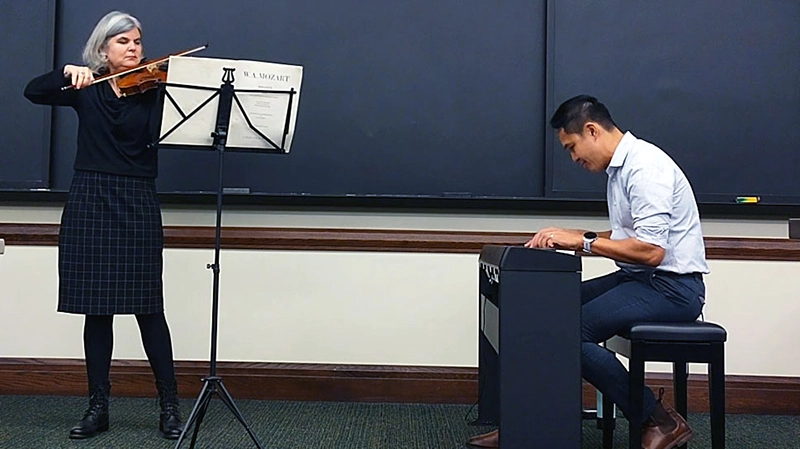
Memory #3: Playing Mozart’s Sonata for Violin and Piano with Licia Carlson as an example of The Enlightenment. More than 20 years after my last formal piano lesson, I had the harebrained idea of a seven-minute Mozart piece with Licia. It was my first semester teaching in honors, replacing an Accinno Award-winning colleague who had just retired (Margaret Manchester) on a long-established team with Stephanie Boeninger — why not perform in front of our students? But as we thought about it, the stars had truly aligned. The Gamm was performing Peter Shaffer’s Amadeus that fall and the college was paying for our tickets. We assigned the play in class, watched clips of the 1984 Miloš Forman movie, even served the students some Viennese pastry to get the full experience. For musicians, the Enlightenment is not just the usual suspects in third semester Civ: It’s the Sonata form, it’s the technological innovation that made a harpsichord into a piano-forte, it’s Mozart asking questions of existence by channeling emotions with revolutionary chord progressions and theme variations. And for the students who saw us perform through nerves, it’s the live sound and the atmosphere that only comes from live performance. Most importantly, it’s a model for what we’re trying to demonstrate as educators: the richness of trusting in your friends, the exhilaration of continuing to take risks, the reward of showing your own humanity by sharing more than what others expect.
In my 10 years at PC, I always laugh when students highlight moments that stuck with them that I thought were forgettable. The time I compared Dostoevsky’s critique of 19th century Utilitarianism to my devotion to California Golden Bears College Football. Sharing pictures of my children from a summer vacation in Montana to discuss the nuances of the early environmental movement.
But the memory I’d like to conclude with is actually from my office hours. It’s a scene that’s repeated at least twice a year when students notice a 25-year-old black and white picture of a college marching band in full uniform in Berkeley. If they squint, students will see a smiling face — my face — with all the joy, excitement, and pride of a college student learning just as much outside the classroom as within. I framed and hung that 2001 University of California Marching Band photograph as my daily reminder that college kids have a lot more going on than what we see as their professors. I was once that student, living a full life outside of the classroom, my attention to learn competing with my desire for experience. It reminds me that I need to create memories in the classroom. When they look back, with the hindsight of history they’ll see that they learned more than they realized. They’ll experience for themselves what we as historians passionately believe: that the past deeply reflected upon is indeed full of meaning.
Alex Orquiza, Ph.D., associate professor of history, wrote this reflection on teaching when he was nominated for the Joseph R. Accinno Faculty Teaching Award at Providence College. He was named the award recipient for 2025-2026.