

Essays by Delasanta, Fortin, and Barbour published by young alumni
By Michael Hagan ’15, ’19G
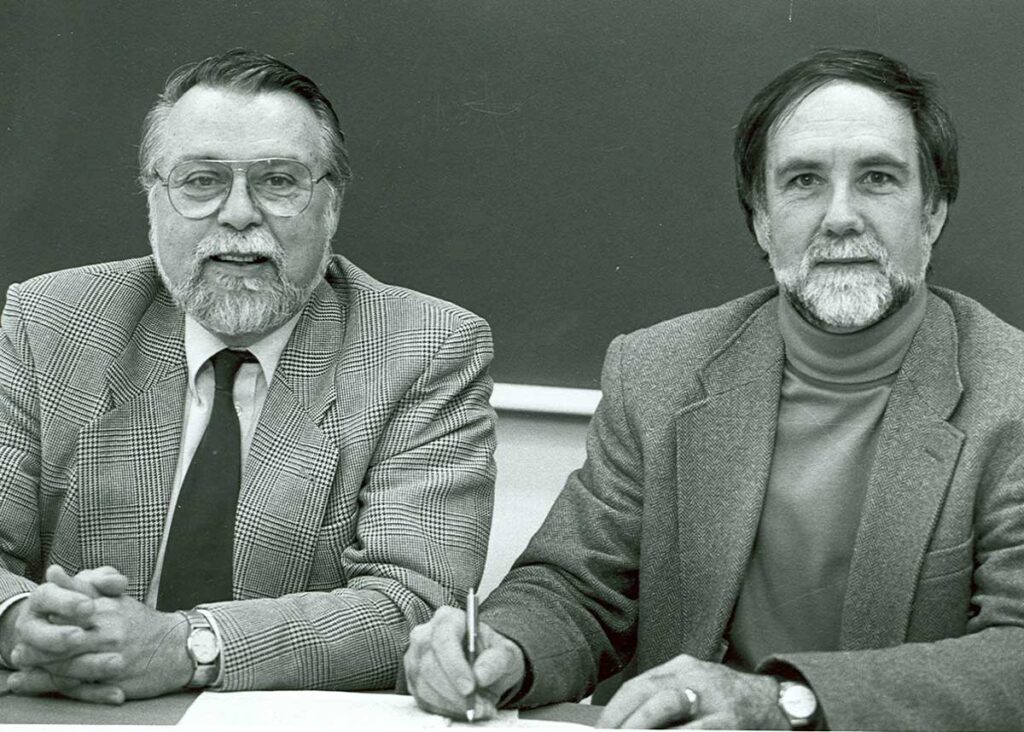
The essays of three celebrated English professors at Providence College — René Fortin, Ph.D.; Rodney Delasanta, Ph.D.; and Brian Barbour, Ph.D. — have been published in a collection by Cluny Media, a publishing company owned by John Clarke ’15 and Scott Thompson ’14, ’18G.
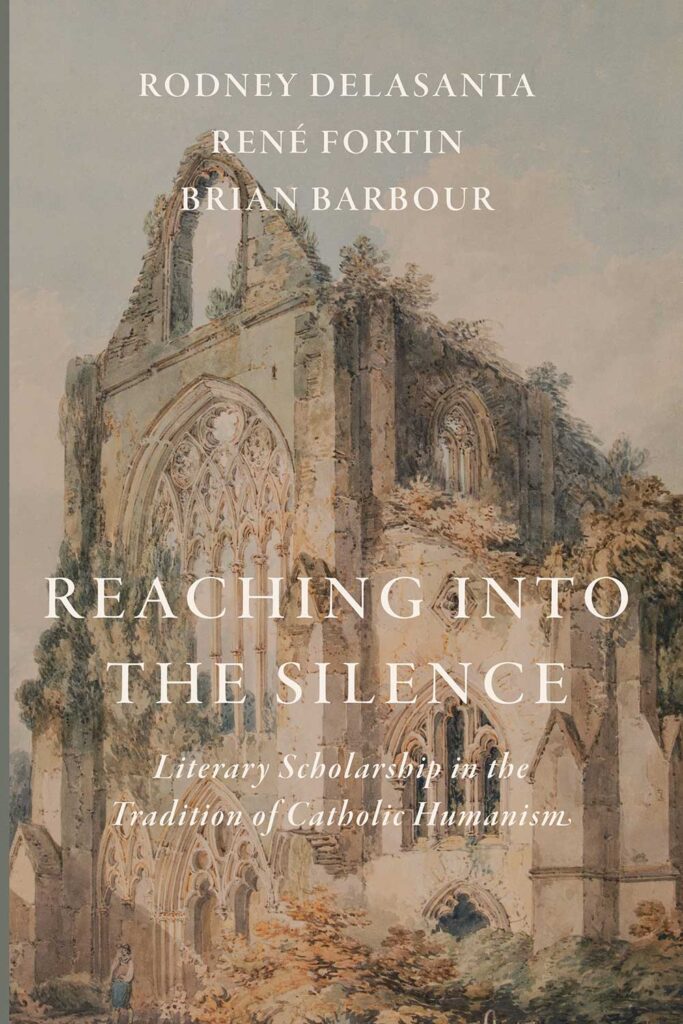
Reaching into the Silence: Literary Scholarship in the Tradition of Catholic Humanism features 35 essays about the works of 17 major authors, from Chaucer and Shakespeare to Jacques Maritain and Flannery O’Connor. The book preserves the literary criticism of the three professors who taught at the college across five decades, indelibly shaping the academic experience, minds, and imaginations of generations of students.
Barbour, now professor emeritus of English, edited the collection, which includes several of his essays. His objective was to preserve “the work of three friends who taught together for decades in the English Department … and had a fairly similar outlook … that can only be called Catholic Humanism: grounded in the Creed and blending a love of letters and the arts with a conviction that reality is sacramental,” as he writes in the introduction.
Cluny Media was established in 2015 by Clarke’s parents, Leo and Kathleen, in partnership with Gellert Dornay, to preserve and promote the Catholic literary and intellectual tradition. They developed the catalog’s initial 18 books before passing ownership and management of the press to Clarke and Thompson in January 2017. Under Clarke and Thompson’s management, Cluny’s catalog has grown to almost 400 titles. Their offices recently moved from a small space in Johnston, Rhode Island to a larger warehouse in East Greenwich, Rhode Island.
PC’s Humanities Program hosted a book launch for the new volume on October 19, 2023, in the Fiondella Great Room of the Ruane Center for the Humanities. Speakers recognized the contributions of the authors as both scholars and teachers:
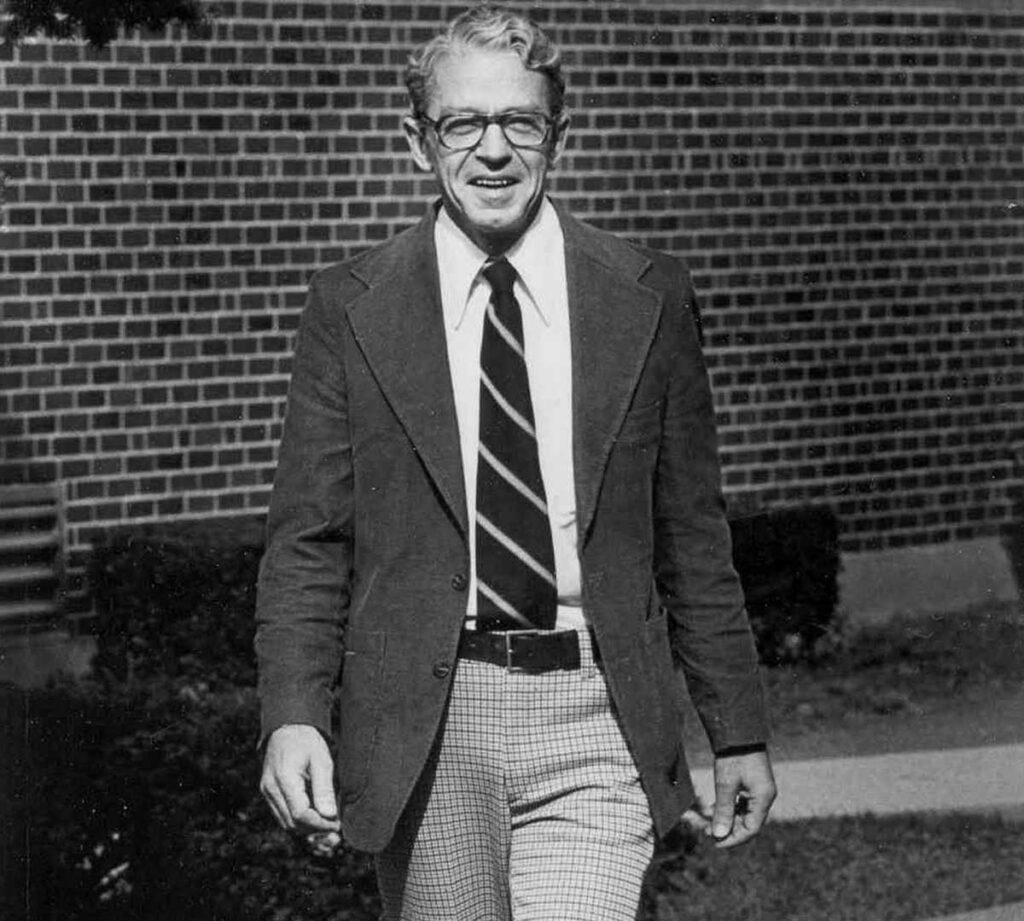
- Fortin, who died in 1991, taught at the college from 1958-1991, directed the Honors Program from 1967–1970, chaired the English Department from 1970–1972, and directed the Development of Western Civilization Program from 1972–1987. He published 20 scholarly articles, many of which are included in his posthumous collection, Gaining upon Certainty, edited by Barbour and Delasanta.
- Delasanta, who died in 2007, taught at PC from 1961–2007, chaired the English Department from 1972–1974, and directed the Honors Program from 1988–2005. He was the author of The Epic Voice and wrote 30 scholarly articles.
- Barbour taught at PC from 1969-2014, directed the American Studies Program from 1981-1984, chaired the English Department from 1986-1988, and directed the Development of Western Civilization Program from 1994–2004. He has edited six books and written 15 scholarly articles, several of which won guild awards.
“I remember someone remarking that René could lecture on the phone book and make it more interesting than Dante,” Barbour said. He credits Fortin and Delasanta each with “classroom instruction of the very highest order.”
In remarks at the event, Barbour described his late friends and colleagues as men who “really loved literature and wanted to convey that love of literature. There is nothing more important to the study of literature than loving literature. If you don’t love it, why do it?”
“Very often, students don’t read for love of literature; they read for the dissection of literature,” Barbour said.
Roy Peter Clark, Ph.D., ’70, ’17Hon., senior scholar and vice president of the Poynter Institute for Media Studies and founder of the National Writers Workshop, spoke via Zoom from Florida. He recalled how the professors molded him as a student.
“They taught me to read. They taught me to read close — very, very close,” Clark said. He described them as “guides like Virgil was to Dante,” introducing him to texts including Dubliners, The Brothers Karamazov, and Death in Venice. He recalled the surprise and pleasure in the professors’ faces when students would comment insightfully in class — led to water by their teachers, but drinking by their own developing strengths.
The professors taught him to “beware the myth of the Golden Age” — the idea that there existed a perfect time in the past that could never be equaled. Clark noted that despite the excellence of his education, it had its limits. Barbour’s first year on the faculty was Clark’s senior year, and Barbour’s class was the first time at PC that Clark studied a work by a female writer.
None of this would be here without them.
Patrick Macfarlane, Ph.D., assistant professor of philosophy
Patrick Macfarlane, Ph.D., assistant professor of philosophy who teaches in the Humanities Program, recalled how an article by Delasanta that he encountered as a graduate student at Duquesne University was his introduction to Providence College.
“The essay was on David Hume and Jane Austen, and I had never read anything like it before. I remember thinking what a great place Providence College must be if there are professors there who read literature and philosophy together like this,” Macfarlane said. A version of that essay, “Hume, Austen, and First Impressions,” is included in Reaching into the Silence.
Macfarlane said it was fitting to celebrate the book in the Ruane Center for the Humanities, which opened in 2013 to house the Civ program the professors helped construct.
“None of this would be here without them,” Macfarlane said.
In an interview about the book, Barbour noted that when Civ launched in 1971, its success was not a foregone conclusion. It took time to organize and unify the program. But the process was as enriching for the faculty as it was for students.

“Teaching Civ changed the way we taught literature,” Barbour said. “We were very aware of historical and cultural background because we were listening to it every day in class. Our sense of how texts fit into the broader culture was immensely strengthened.”
The essays in Reaching Into the Silence are born of the interdisciplinary, humanistic approach to teaching literature that Civ was built upon.
“Nearly every paper had its origins in classroom teaching,” Barbour said.
To Barbour, Delasanta, and Fortin, the study of literature was not centered around theory or fixed method, but rather “the words on the page.” What is this text? How does the work generate meaning? And what is that meaning? These were the most important and abiding questions and the substance of lively discussions over regular lunches shared by the three friends and their colleagues.
At these lunches, one professor would remark that another’s comments in lecture prompted a thought. From there, ideas would fly. These faculty shared “a living force, quickening our minds, and enriching our own work going forward,” Barbour writes.
“We were blessed and we knew it.”

John Clarke gave a talk in New York City last year based, he said, on Barbour’s essay, “Lewis and Cambridge,” which was published in Modern Philology in 1999 and republished in Reaching into the Silence.
“It’s an essay that continues to guide me today,” Clarke said. “Professors like Dr. Barbour changed the way I thought about the relation of ideas to reality. They taught me to see the world sacramentally. Much of my work at Cluny is following the literary threads that he and other professors placed in my hands.”
Clarke, who majored in philosophy and classics, now lives in New Hampshire, with his wife, Susannah (O’Brien) Clarke ’17, and their four children. Thompson, who added an MBA to his undergraduate degrees in theology and finance, resides in North Kingstown with his wife, Emily (Corr) Thompson ’13, and their four children. They hope to grow Cluny’s market and sustainability so that its mission of preserving books at risk of being forgotten by larger publishers can endure for decades to come.
They appreciate their partnership with Barbour, who sent Clarke a personal note when his youngest son was born.
“Dr. Barbour could pick and choose collaborators and publishers, but he chose us,” Clarke said. “That’s an honor.”
Reaching Into the Silence is available for purchase from Cluny Media.